
During Holy Week 2026, I stayed with the Sisters of Saint John the Evangelist, known as the “Juanistas”, in Chinauta, Colombia. There I experienced a Paschal journey, expressed in concrete gestures of tenderness and service to the elderly Sisters.
The hour of faithfulness in the face of limitation and illness
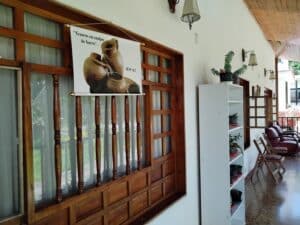
Upon arriving at the home for elderly Sister, I was met by the faces of Sisters full of tenderness and warmth. As the days passed, I witnessed spirituality in action, expressed through liturgy. I heard singing, saw the flowers being tended, I was surrounded by plants that bring beauty.
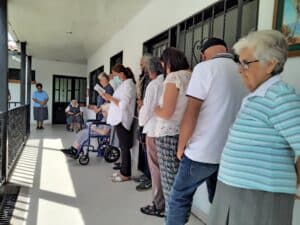
I felt a spirituality made up of welcome, hugs, kisses, gestures such as spoon-feeding a sick Sister, praying together, eating together, listening, accompanying, serving, keeping silence, and practising personal and communal devotions. Everything was an opportunity to bear witness to the God who dwells within us.
Although it is a retirement home, the Sisters do not see it as a time for withdrawal; it is rather, a time to remain true to the essence of who each of us is, and in so doing, to make this world a more humane place where Jesus, our Easter, reigns.
Rites of faith become cognitive-neural therapies
Community activities bring joy and serve as points of support for discernment and bearing witness. I saw an example of this in the homily shared by each Sister, or the reading of the Gospel in the evening after supper as a way of preparing for the following day. One Sister comments on or recounts the text in her own words; this, as well as being an act of spirituality, is a form of neural therapy that improves memory.
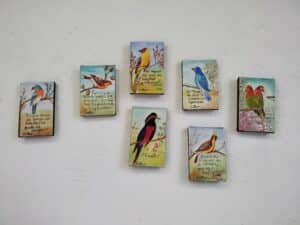
What’s more, the household chores become a form of daily therapy and a meaningful part of life. Each older sister takes on a task and carries it out with love: one sets the table, another washes the dishes, another prepares the altar, and another collects the medicine blister packs and empty jars.
Each, according to her strength and inclination, renders a service to the community and improves the ambiance for everyone. Some, for example, fill plastic bottles with the blister packs, and the gardener builds fences for the garden, which become a visual message of beauty and care for our common home.
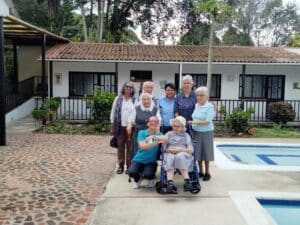
“Put your finger into the wound in my side …”
The stresses of pain associated with ageing, such as senile dementia, osteoarthritis, hearing loss, unexpected falls, hospitalisations, the refusal of medication by health insurance providers, and multiple diagnoses affecting a single sister—among other challenges of life on a country estate—are managed in a more sisterly manner through:
• Through the openness of the younger Sisters in charge, they foster friendship in the manner of Saint John the Evangelist, the Lord’s friend. For example, neighbours and Vincentian priests come to celebrate the Eucharist with the Sisters, and other Sisters or lay friends also come to support this mission with love and joy on occasion.
• Personalities with a sense of humour, such as Sr Carmen, who, in the middle of her dementia, finds something funny in everything.
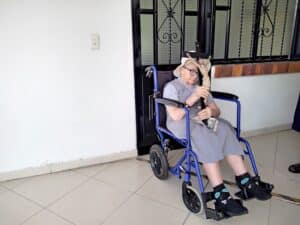
• The tenderness of Sr Libia, who, whilst bedridden, allows herself to be cared for and inspires such tenderness that one feels compelled to give her gentle kisses and hugs.
• A support staff who carry out their work with love, integrity, joy, and dedication.
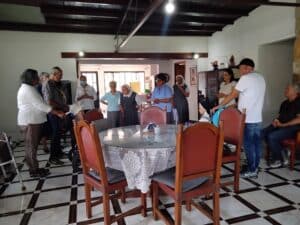
In old age, life is not easy with all its different personalities and ailments, but remaining faithful to the best in each of us makes this time of vulnerability a place where God works wonders. For example, during the Way of the Cross, the older Sisters surprised us with the way they prayed so intimately for the reality of the country and the people they know; this was a true witness which I admired and wish to imitate.
As a Daughter of Jesus of Kermaría, I learnt this Holy Week that when the mission is lived in relationship with the Lord who sends us, regardless of age, he comes out to meet us alive, joyful, and risen. Beyond our limitations, there is room for tenderness, for service with love and joy, and it is there that Jesus conquers death and lives on in the Resurrection. As our Rule of Life No 5 tells us, this gives meaning to our lives and to our history.
Viviana Carolina Forero Angulo, FJ
Honduras
0 Comments